
Last month, we had the opportunity to partner with a local organization, Paws For Patrick for an event for therapists centered on integrating emotional support animals (ESAs) into mental health practice. Daniel Maigler, LCSW, and Craig Scalise, PhD, delivered an incredibly informative and engaging presentation, and we’d love to share a bit about what we learned.
What are Emotional Support Animals?
We often hear the terms “service animal”, “emotional support animal”, and “therapy animal” used interchangeably. However, each of these phrases hold different legal definitions, training requirements, and public access rights. An emotional support animal (ESA) is a companion animal whose owner has documentation from a qualified therapist of a mental health condition, such as Major Depressive Disorder, Post Traumatic Stress Disorder (PTSD), or Obsessive Compulsive Disorder (OCD), for which the animal helps the individual achieve progress in their mental health journey. In other words, the absence of the animal would increase symptom frequency, intensity, or duration.
ESAs require the least level of training among therapeutic animals, compared with therapy animals and service animals. ESAs are a disability accommodation; that means that owners cannot be barred from “no-pet” housing or charged pet deposits or fees from landlords. Since we work with many college students and young adults in Evanston, this can be particularly helpful to know as we support them and their needs for campus housing or local rentals.
What Are The Benefits of Emotional Support Animals?
Several studies demonstrate the therapeutic power of ESAs. Emotional support animals have been associated with significant reductions in loneliness, depression, and anxiety scores. An interesting fact: in one of those studies, cats were found to decrease depression slightly more than dogs! Animals also help ease isolation, introduce and inspire humor in life, provide nonjudgmental companionship, and reduce levels of cortisol, mediating stress.
What Do Therapists Need to Know About Emotional Support Animals?
It’s no wonder that animals can provide support for individuals navigating their mental health. Yet, there still are a variety of misconceptions about ESAs. One of those myths is that it’s a conflict of interest for a therapist to write an ESA letter for their active client. This couldn’t be less true! Ongoing clinical knowledge of a client’s condition(s) and needs is exactly what makes a clinician a reliable verifier. Here at Connections, we have established guidelines for our therapists to promote ethical best practices. We suggest that they be working with a client for at least one month prior to beginning the process of writing an ESA letter. Since landlords often offer year-long leases, we review this documentation on an annual basis, to ensure it reflects an active, current therapeutic relationship and the ongoing, current need for this accommodation.
We learned that in assessing fit, not only is it important to have reasonable belief that an ESA will help an individual’s symptoms and quality of life, it is also imperative to weigh a client’s affinity for animals, the responsibility and schedule of pet ownership and care, and the impact on others who may also live in the home. It’s also essential to explore an animal’s temperament, size, energy level, and expected expense. For example, a survivor of domestic violence may feel safer with a larger dog; this can then impact their search for an animal and their associated expectations. Something we were also interested to learn was that a person can actually have multiple emotional support animals, that each serve a unique purpose.
Conclusion:
Emotional support animals can absolutely fit into a broader treatment plan. At Connections, we seek to ensure that each individual we work with genuinely qualifies for – and stands to benefit from – an ESA. We hope all of this intentional communication and collaboration can ultimately support our clients, their wellbeing, and their emotional support animals.
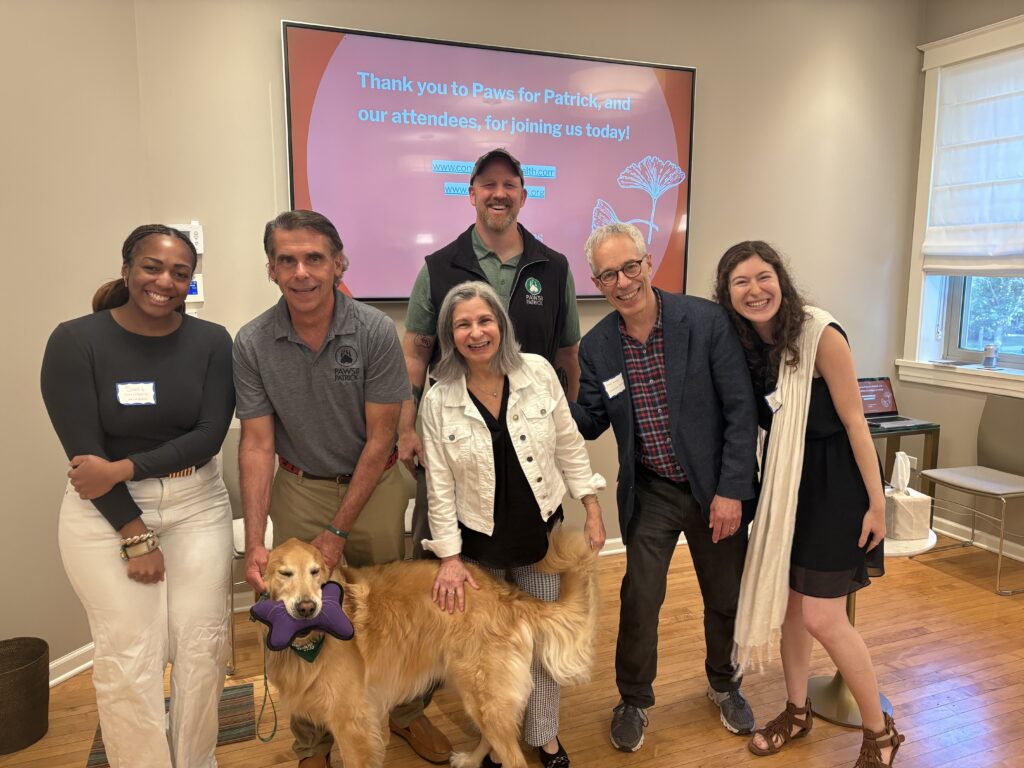
We were very grateful to learn from Craig and Dan last month, who are deeply passionate about their work at Paws for Patrick, an organization dedicated to supporting the mental health of young people through connection with animals. If you’re interested in learning more about Paws For Patrick and supporting their mission, you can visit their website here. Below you’ll see a photograph for our event, featuring Cali, Dr. Scalise’s therapy dog!
As always, we welcome your thoughts and insights as a mental health professional. We also hope to host an educational event geared towards the local student community on ESAs too. Have any feedback on this topic, or an idea for a blog, workshop, or program? We’d love to hear from you!
Related Articles

Setting The Stage: Earlier this year, Connections Health Clinical Director Claudia Rosen, LCSW, delivered a spark talk at a symposium focused on digital technology and socioemotional wellbeing at the Northwestern University School of Education and Social Policy. Both in preparing for that presentation and in the months since, we have been increasingly interested in this [...]

Why Does Rejection Hurt? Have you ever felt rejected by a friend, family member, supervisor, or romantic partner? It can be a universally painful experience. It stings. As humans, we are prosocial – we look for the approval and affirmation of others to guide our actions and to develop a sense of self and self-worth. [...]

Have You Ever Heard of ‘Mattering’? Many of us may belong to book clubs or simply enjoy reading alongside others and swapping recommendations. Recently, we had the opportunity to read a newly published book by Jennifer Breheny Wallace titled “Mattering: The Secret to a Life of Deep Connection and Purpose.” This book offers a compelling [...]